MacBook Pro with PROLED XDR Display adds Touch to the Mac
Apple's MacBook Pro with PROLED XDR Display is the first Mac with Touch. It starts at $2,899, ships November 6 and runs macOS 27 with M5 Pro or M5 Max.

Written by Mac App Index Editorial
MacBook Pro with PROLED XDR Display: first Mac with Touch
Apple announced the MacBook Pro with PROLED XDR Display on 28 October 2026, a 14- and 16-inch laptop with a tandem OLED screen and Touch input, which Apple describes as Touch on the Mac "for the first time". It runs M5 Pro or M5 Max chips and macOS 27 Golden Gate. Pre-orders opened the same day, with deliveries from 6 November 2026.
The MacBook Pro with PROLED XDR Display is the first Mac with a touchscreen. Many existing apps respond to touch with no changes, and apps that adopt Apple's updated gesture APIs can add touch-specific features. Prices start at $2,899 for the 14-inch M5 Pro, with deliveries from 6 November 2026.
What's new in the MacBook Pro with PROLED XDR Display
- Touch. Users can scroll with a swipe, pinch to zoom, drag slides between presentations, double-tap a window to fill the screen and flick it to tile it into place, according to Apple's press release. Apple says the touch sensor is built into the display panel instead of layered on top. Touch works alongside the keyboard and trackpad.
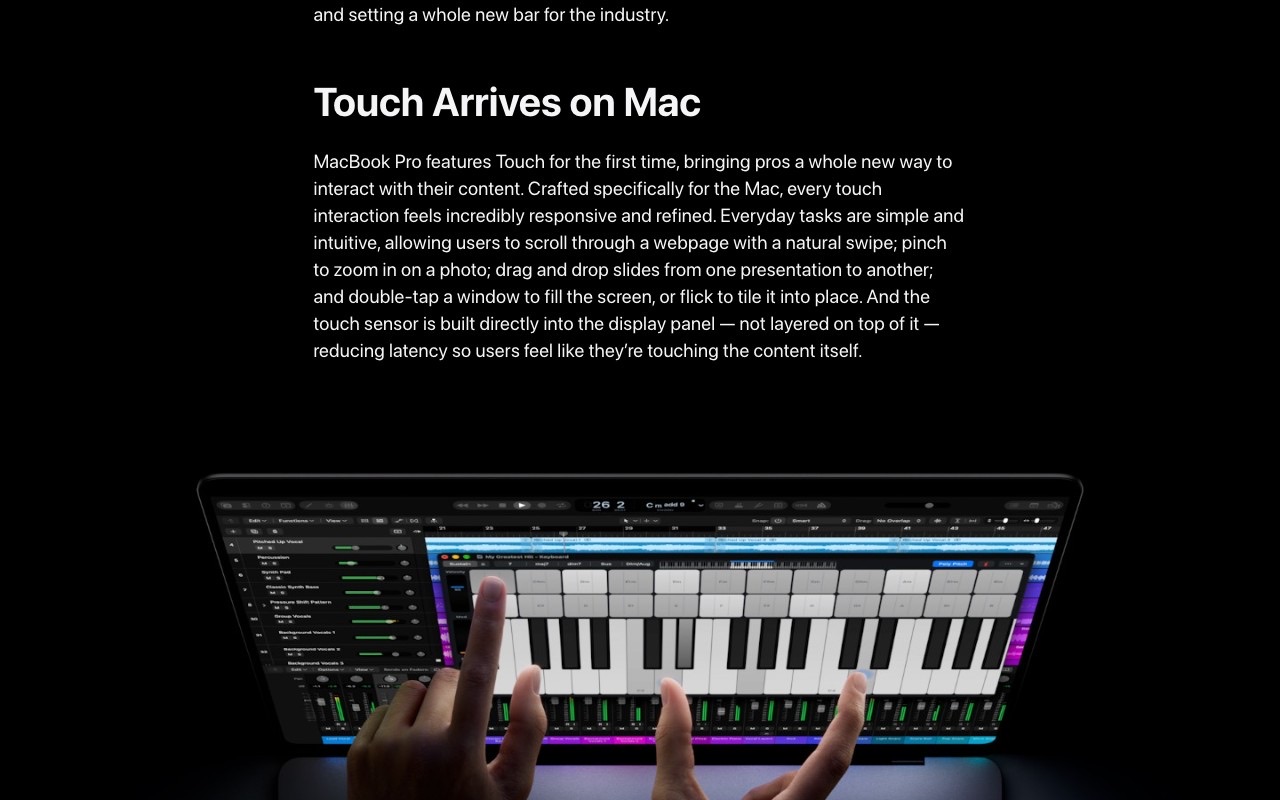 Source: Apple Newsroom, captured 28 October 2026.
- App support. Apple says many existing apps work with Touch right away "because macOS automatically translates touches into clicks." Apple lists Notion, Canva, Zoom, Microsoft Word, Excel, PowerPoint and Outlook, Adobe Lightroom, DaVinci Resolve, Blender, Maxon Cinema 4D and ZBrush, Shapr3D and Algoriddim djay Pro as apps that will take advantage of Touch.
- Apple Creator Studio. Pixelmator Pro lets users draw, paint and select directly on the canvas. Logic Pro gets a Multi-Touch polyphonic keyboard with tappable chord and drum pads. Final Cut Pro lets editors mark ranges, drop clips into place and pinch to zoom on a cut. The updates reach the App Store in November, free for existing subscribers. New subscribers pay $12.99 a month or $129 a year.
- Developers. Apple says app developers can test Touch in their iOS and iPadOS apps directly on the display.
- Display. The tandem OLED panel reaches 2000 nits peak HDR and SDR brightness with a 10,000,000:1 contrast ratio and covers P3 and Adobe RGB. Macworld notes that sustained full-screen brightness stays at up to 1,000 nits.
- Dynamic Island. It replaces the notch and hosts Spotlight, Live Activities and Siri AI. 9to5Mac reports that the machine still uses Touch ID, with no Face ID and no built-in cellular option.
- Chips and weight. The chips are M5 Pro and M5 Max, up to 128GB of unified memory and up to 16TB of storage. The 14-inch model weighs 3 pounds and the 16-inch weighs 4 pounds, per Apple.
At a glance
| Detail | Value |
|---|---|
| Product | MacBook Pro with PROLED XDR Display |
| Announced | 28 October 2026 |
| Sizes | 14.2-inch and 16.3-inch displays |
| Chips | M5 Pro, M5 Max |
| Price (U.S.) | 14-inch M5 Pro from $2,899; 16-inch M5 Pro from $3,399; 14-inch M5 Max from $4,499; 16-inch M5 Max from $4,799 |
| Education price (U.S.) | From $2,749 for the 14-inch M5 Pro |
| Pre-order | From 28 October 2026 on apple.com/store and in the Apple Store app, in 30 countries and regions |
| Available | From 6 November 2026 |
| Software | macOS 27 Golden Gate |
What it means for Mac users
Touch matters most for people who draw, play or edit directly on screen. Graphic designers can use the whole display as a canvas instead of the trackpad area, which is where Pixelmator Pro's new canvas controls apply. Musicians get an on-screen keyboard in Logic Pro. 3D and video users should watch Blender and DaVinci Resolve, which are both on Apple's list of apps adopting Touch.
Window managers face a small overlap. Apple's double-tap to fill and flick to tile cover part of what Rectangle does with keyboard shortcuts. Whether the built-in gestures are enough depends on how much of your tiling you do by keyboard.
The upgrade is about the screen and the interaction model, not speed. Macworld reports that the new models keep the same chip families, memory options and advertised battery life as the non-touch M5 models, and that U.S. starting prices are $400 higher. Apple still sells non-touch MacBook Pros. Macworld also reports a separate 14-inch M6 MacBook Pro, announced on 27 October 2026, with the existing design and display. Compare the creative apps above, with their prices and macOS requirements, on Mac App Index.
What to watch
The open question is how many of the named third-party apps ship touch updates by 6 November 2026, and how quickly the Apple Creator Studio updates arrive on the App Store in November. Touch-first features in an app depend on the developer adopting the new system gesture APIs.
Key takeaways
- Apple announced the MacBook Pro with PROLED XDR Display on 28 October 2026 as the first Mac with Touch.
- macOS 27 translates touches into clicks, so many existing apps respond without an update.
- Pixelmator Pro, Logic Pro and Final Cut Pro get touch features in an Apple Creator Studio update due in November.
- The U.S. price starts at $2,899 for the 14-inch M5 Pro and $4,799 for the 16-inch M5 Max, with deliveries from 6 November 2026.
- The chips are M5 Pro and M5 Max, the same families as the non-touch models.
FAQ
Is the MacBook Pro with PROLED XDR Display the first Mac with a touchscreen?
Yes. Apple's press release of 28 October 2026 describes Touch on the Mac for the first time, built into the display panel of the 14- and 16-inch models.
Do my existing Mac apps work with touch?
Many do. Apple says macOS automatically translates touches into clicks, so many existing apps work right away. Touch-specific features, such as drawing on a canvas, need an app update that uses the new gesture APIs.
How much does the MacBook Pro with PROLED XDR Display cost?
In the U.S., the 14-inch M5 Pro starts at $2,899 and the 16-inch M5 Pro at $3,399. The M5 Max models start at $4,499 for 14 inches and $4,799 for 16 inches. Deliveries begin on 6 November 2026.
Does it use a new chip?
No. It uses M5 Pro and M5 Max, the same chip families as the existing non-touch MacBook Pro models, according to 9to5Mac and Macworld.
Source: Apple Newsroom
If you are choosing creative software for the new display, the Design & photo category lists the options.